Saint Ilain, the Great Prophet of Ætaine
The Golden Son of the Goddesses
Few religious figures survive serious historical scrutiny with their reputations intact. Saint Ilain of Ætaine, called the Great Prophet of the Gods and, more affectionately, the Golden Son of the Goddesses, appears to be one of the few that does.
His childhood and youth are almost entirely unknown. No reliable record identifies where he was born, who raised him, or what occupied the first two decades of his life. The only personal detail that appears consistently in later accounts is his extraordinary affection for his unknown mother, whom he praised often and credited with helping him understand his place in the world and giving him the courage to start his mission for the Goddess of Light. Ilain himself enters reliable history only in 844 ÆC, in the city of Ætaine, at twenty-one years of age. He remains the only person known, and verified according to temple records, to have borne the blessings of the Goddesses of Light, Fate, and Magic simultaneously.
For the next fifteen years he wandered much of the continent preaching an exceedingly simple doctrine: cherish life, and each other, beneath the Light; show kindness where cruelty would be easier; and never assume any person has wandered so far into darkness that redemption has become impossible.
His prophecies were equally remarkable. Numerous surviving accounts record predictions he attributed to the Goddess of Fate that later occurred with uncomfortable accuracy. One such example being the accurate prediction of the volcanic eruption of Mount Anataiya in the Kingdom of Kristin. His healing abilities were even greater still, and quite honestly, unbelievable. In 847 ÆC, following the collapse of a massive tenement in Ætaine’s poorest districts, contemporary records claim Ilain healed several hundred injured people at once. I have found accounts from temple officials, city authorities, soldiers, and ordinary residents; all carefully preserved by the Ætaini Temples of Light, Fate, and Magic. Irritatingly for the skeptic in me, they agree on nearly every important detail, including his skill with aether. To someone who has witnessed great healing magics, the idea that someone could heal more than one individual at a time is incredulous. But it happened.
Ilain usually traveled alone. However, frequently enough, his family and disciples joined him on his mission; occasionally he marched alongside Ætainese armies, though he apparently cared little whose banner flew overhead. After battles he healed Ætainese and enemy wounded alike. This earned him considerable admiration and, inevitably, enemies. Several attempts were made upon his life during his ministry, and on more than one occasion his followers physically placed themselves between their prophet and those who wished him dead. The most notable example of this occurred in 857 ÆC, where a dozen of his disciples died thwarting a pale-aelvar assassination attempt while they were in the city of Krystin.
In the summer of 859 ÆC, during one of the many wars and battles between Ætaine and Drak’nir, Ilain was captured by Drak’niri soldiers while healing the wounded from both armies. Following a turn in the battle against the Drak'nir Empire, they executed him. The surviving accounts state that he healed the very soldiers ordered to execute him. When he was killed, witnesses across the battlefield reported a burst of golden light brighter than the midday sun. Every injured person, no matter how dire, within several leagues was said to have been healed.
Ordinarily, I would dismiss such a story as the inevitable embellishment surrounding a martyr. Unfortunately, there are simply too many contemporary, independent witnesses from both sides.
Ilain remains the most widely venerated saint among those who worship the Righteous Gods, and his teachings concerning compassion, joy, peace, and redemption have survived him far better than most kings have been survived by their vainglorious monuments. His wife Theophani, and two young sons Elain and Nalain, disappear from records soon after, their fates unknown.
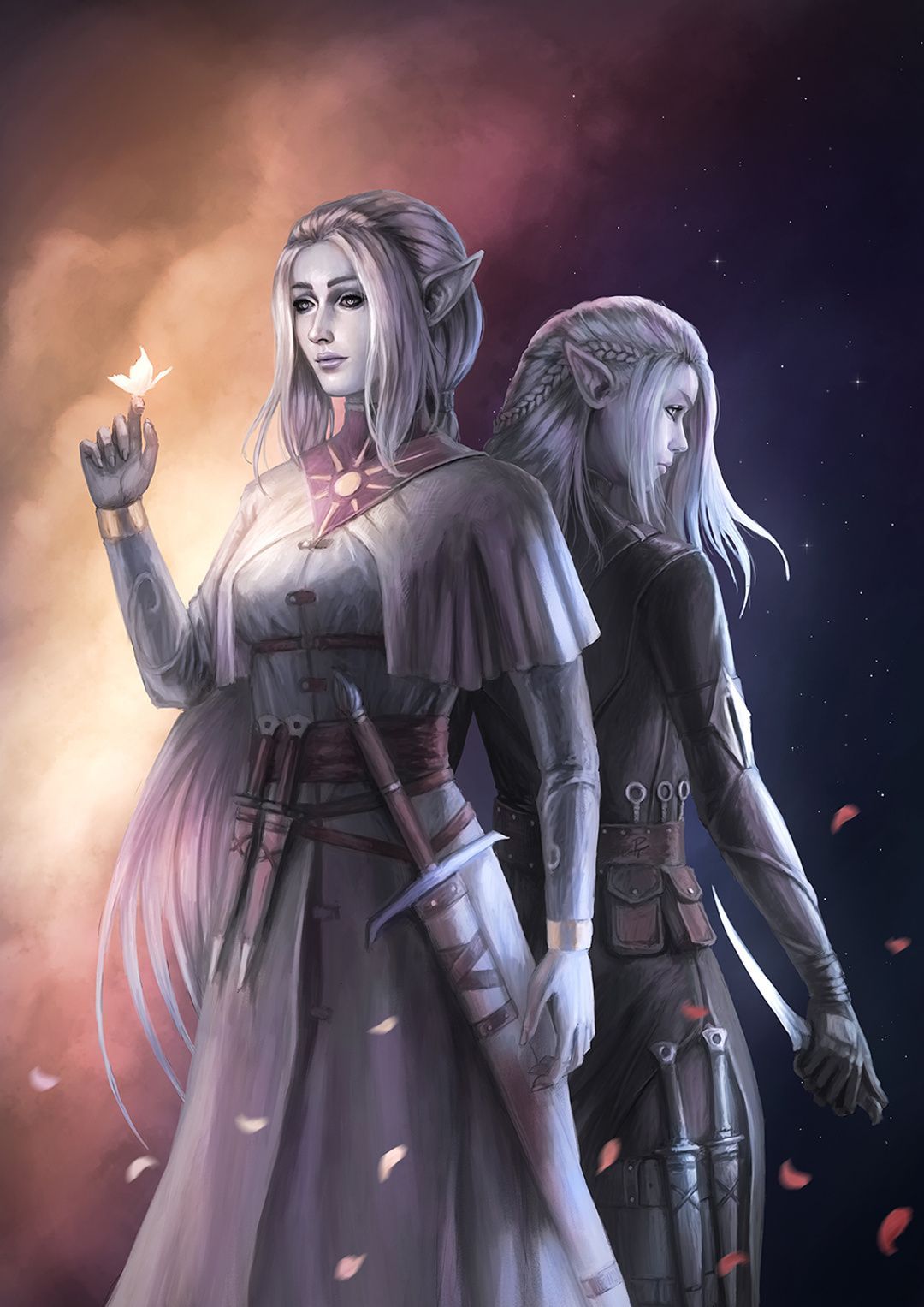
I have noticed something else, though I do not know what to make of it. Isha venerates Saint Ilain more deeply than I would expect from someone so outspokenly uncomfortable with saints, holy figures, and organized church structure even though she is the Light's Blade of Valmark, the defender of the city's faithful. I have found her more than once kneeling before his statue in Valmark’s Temple of Light when I sought her out, sometimes remaining there long after her prayers should have ended.
Perhaps she sees in him an example of the person she wishes she could become?
Or perhaps… there is something I do not know.
With Isha, there usually is.
— from the research notes of Zyr’Magi Tes’Lothen, “Magi the Blade”, high-aelv scholar, mage, and swordsman
More From the Blog
News
Magi's Research Notes
Characters
Locations
Excerpts
Recent Posts