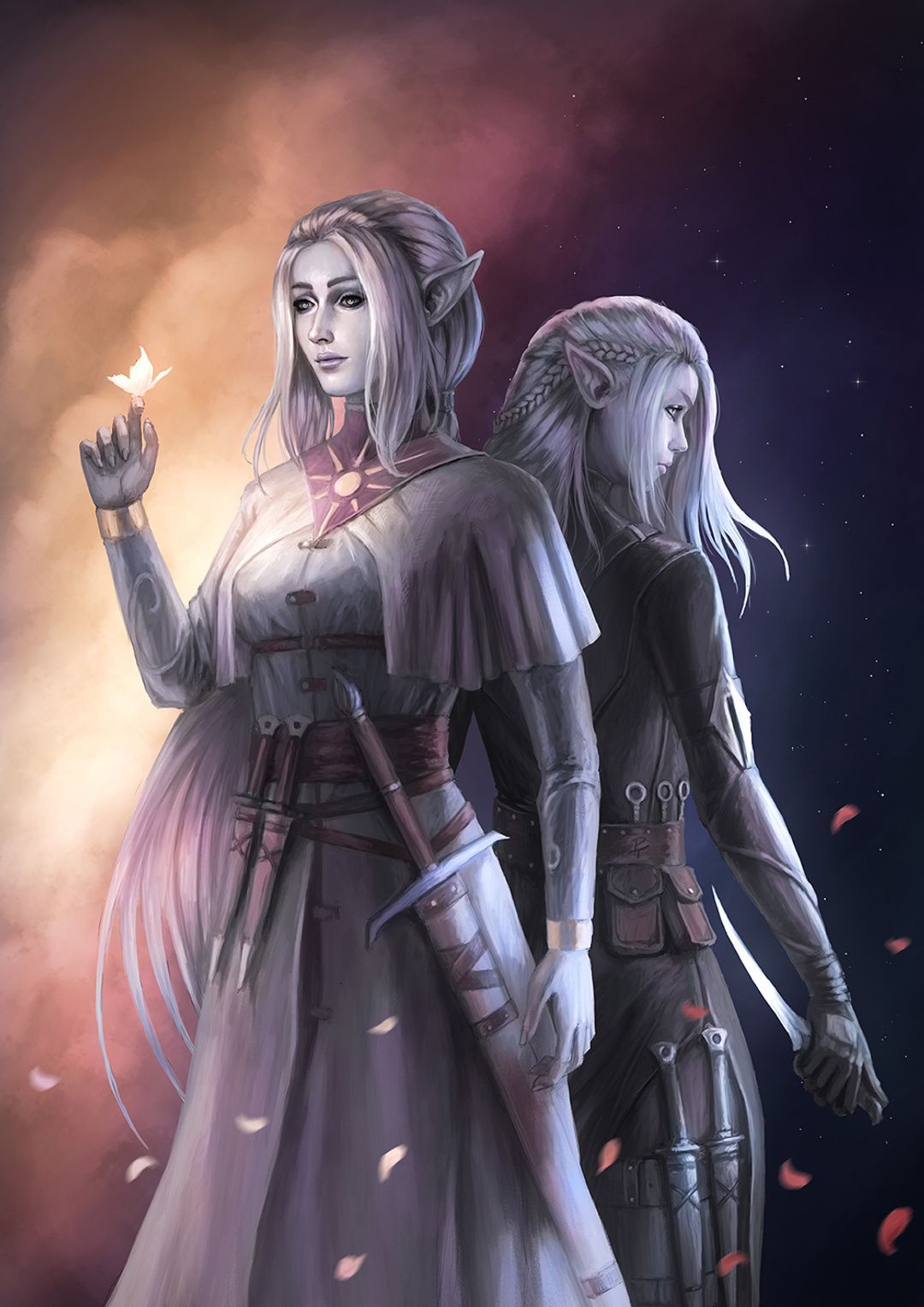
The Assassin Priestess: The Silver Wraith, Ch. 3
Chapter Three: The Price of Belonging
The morning after I killed the woman, I sat upon the edge of my own bed and waited to become hungry again.
An empty tray and bowl rested on the table beside me. There was still bread upon the tray, a little cheese, and two slices of cured meat that I had arranged together near the edge of the plate. I could reach them without standing.
For the first time in my life, I did not want more food.
This troubled me enough that, for a time, I thought of little else.
The meal had been brought after I woke: soft wheat bread with a pale center thinly sliced cured meats cheese, and a bowl of warm beef and vegetable soup. There had been pieces of meat in the broth large enough to require chewing. I had counted them before I began, getting to twenty three, then eaten the smallest first so the others would remain.
No hand had reached over my shoulder to take one.
I had eaten the bread quickly, until I remembered that I was alone. Then I had tried to eat more slowly. The cheese was soft under my thumb instead of hard and crumbling. I had never known food could taste so different from one mouthful to the next, or that I might wish to savor the taste in my mouth rather than swallow it.
When the bowl was empty, I had lifted it to my lips to be certain I had missed nothing.
That was when, as I had reached for more bread, I discovered that I did not need it.
I pressed one hand against my stomach.
The familiar ache was absent. Not weakened. Not briefly distracted. Just completely absent. In its place, there was a fullness that made bending uncomfortable.
I could not remember having felt such a thing before.
There had been food since Thalir brought me from the orphanage, but this was the first meal I remembered ending because I had eaten enough. I kept looking at what remained, expecting someone to enter and demand why I had stopped.
No one came.
Eventually, I wrapped a piece of bread with the remaining meats and cheese in a clean cloth and placed it beneath the pillow.
Being full did not make me believe I would be fed tomorrow. I had ten years of habits that I had yet to break.
The pillow was mine as well from what I was told the night before.
I touched it after putting away the bread, then passed my palm over the blanket. Both lay upon a bed meant for one person. It was too large for me, though I was no larger than a human girl of five, and almost anything built for an adult seemed enormous. I had slept close to one edge, scrunched up next to the stone wall, still afraid of my new environements.
Across from the bed stood a closet. Inside hung two clean, black tunics, and a heavier garment for going outside. There were stockings on a shelf, shoes beneath it, and empty space for things I did not possess. I had opened the door several times already, merely to see whether everything remained.
A small mirror hung beside the washstand.
I had been told that the room, and all within it, was mine. Not mine until another child needed it, or mine if I held it against another. It was mine because I belonged to the Kol family now. I was now Asyr'Isha Kol'Morren.
I sat a little straighter whenever I remembered that.
There are parts of this memory I would find easier to recount if I could say I had been miserable throughout it. A frightened child brought into a cruel household ought to have recognized the cruelty. At least, that is what those who have never needed such a household would say.
I had eaten. I was warm. Someone had given me new clothes without first taking them from another child in front of me. My name no longer ended in two numbers.
I was actually happy.
The woman I had killed the night before was dead, and I was happy.
I have not found a more apt way to tell the truth.
I climbed down from the bed and went to the mirror. A narrow shelf beneath it meant I had to stretch to see all of my face. My short white hair stood crookedly where it had pressed against the pillow. One cheek was still bruised from the test four days before, though most of my other injuries had been healed. Beneath my new tunic, my body was as small and thin as it had been before the ceremony.
For some reason, I had expected some other difference.
The previous night at midnight, they had taken me into the temple for the Joining Ceremony. Obsidian stones covered its walls and pillars. Above the open center of the Temple to Du’Tariál, both moons had been full. Their light had caught upon the black surfaces and upon the faces gathered around the altar.
I could not clearly see many of their faces due to the hooded robes they wore, though I could tell some had watched me. Others had watched the woman. One man had adjusted the fastening of his sleeve while Thalir spoke, between chants.
To him, it had been an ordinary ceremony.
To me, it had been the night I received a family.
It took me a while to fully come to the realization that the woman had belonged to this same family before me.
They had called her a Lost One. She had run away, been caught, and been brought back. What had followed had not been called torture in my hearing, but that was what they had done to her. Her long ears had been clipped short like a human’s. They had stripped her and bound her upon an obsidian altar, with a bloody gag between her teeth. In the future, I would do the same thing to others that had been done to her as I rose in the ranks of the family.
I had tried not to look below her face at her injuries; her face had been bad enough.
One eyebrow had risen slightly higher than the other, even when both drew together in fear. There had been a small cleft in her chin and a dark ring around each silver iris. Her short hair had caught beneath the binding at her cheek. She had tried to turn her head when I approached, then focused her attention on me for the remainder of the ceremony.
I can still see the moment her eyes first settled upon mine.
I do not know what she thought of me. Despite my exceptional memory, there is a fog hanging over that night, though I do not know why. Maybe because she was my first. I do know I could never receive her forgiveness in any event, as she did not have the opportunity to offer it. Nor can I pretend that I understood whatever she had tried to say through the gag. I feel I did know, but the memory remains hazy to this day.
I knew only that she had been alive when picked up the obsidian dagger from the stand next to the altar.
Thalir had told me I would give her mercy. She would suffer no longer, and I would be welcomed among those who served the Goddess of Darkness faithfully. He had spoken gently, as though explaining why a child must finish an unpleasant chore before joining the others at supper.
I had tried to look toward the adults around the altar, but my focus was locked on her.
None had objected. They only continued their chanting.
I had wanted someone to tell me there was another task I could do instead.
No one had.
The dagger had looked like a piece of the temple in my hands: black, smooth, and cold. I had been lifted up the first step of the altar because I could not reach it from the floor. Then I had done what Thalir required. I had driven the dagger into her chest.
That is as much as I wish to describe of the wound.
The act itself has never required much description to return to me.
I had cried afterward. Thalir had wiped my cheeks, praised my obedience, and told me the family was pleased. Several voices had repeated my new name. Without the old numbers. They said it with my new toponym, alongside my family and clan name in their proper places.
No one had asked whether I was crying for her.
Standing before the mirror the next morning, I raised the hand that had held the dagger.
It was clean. I cannot remember who had washed me and changed me out of my rags from the orphanage into my new black clothes before putting me to bed. The little scratches across my knuckles came from the orphanage, and the nail I had broken there was still uneven. I examined each finger, then closed my hand and opened it again.
The girl in the mirror did the same.
I did not understand how she could look so much like the girl I had been before. I knew, even at my young age, that I crossed a line there was no coming back from.
She was hurting, I told myself.
That was true. I had seen enough to know it.
She is not hurting now. That was what Thalir had said.
I tried to make those two thoughts settle the matter. They would not account for the way she had looked at me. They would not explain why someone receiving mercy had been bound so tightly, beaten and scarred so much prior to the ceremony, nor why no one had removed the gag to let her ask for it.
I turned from the mirror and opened the closet again.
The tunics were still there.
I touched the sleeve of one. Its seam had been sewn evenly, with none of the hard knots I had learned to sleep against at the orphanage. There was a small repair near the hem, but the cloth was sound. I put my hand inside the sleeve and imagined wearing it tomorrow.
Tomorrow there would be another meal. I would sleep in this bed again. Thalir would come to see me, and perhaps he would call me his daughter where the others could hear.
I wanted all of it.
I also wanted the woman to be alive.
Since I could not have both, I began persuading myself that what I had received was worth what had happened.
It was a stupid child’s reckoning. I did not sit beside the breakfast tray and deliberately measure a stranger’s life against bread to eat and warm blankets to sleep under. Instead, I thought that I must have done something good, because good things had followed it. The adults had praised me. My new family had accepted me. The woman had been suffering, and they said I had ended that suffering.
Surely I was allowed to be happy about my new life.
I needed permission even for that, and there was no one in the room to grant it.
So I decided to delude myself and grant it to myself.
I shut the closet and smoothed my tunic. When her face returned, I counted the stitches along my cuff. When I remembered the gag, I inspected my soft, leather shoes I wore. I did not forget her. I could not. I learned only that I could direct my attention elsewhere, and that if I did so quickly enough, I might keep the worst of the feelings from overpowering me.
I became very practiced at that over the years as my death-toll mounted.
It never made the feeling disappear. The pain always lingered in my chest.
As I was looking at my shoes, a knock sounded at the door.
I startled so sharply that my heel struck the bed frame. Before I could decide whether I was supposed to answer, Thalir entered, swinging open the door quickly.
“Veilsshadow Isha.”
He smiled when he said it.
I stood straight, although the title still seemed too new to belong to me. I had been told it marked the beginning of my training. To my mind, it meant that someone expected me to remain long enough to learn. That made me happy.
“Have you eaten?” he asked.
I glanced at the tray.
“Yes, Father. There is some left.” I decided against lying immediately in case he searched my room.
He glanced around the room quickly and then turned his attention back to me. “Have you had enough?”
I nodded.
“Good.”
He did not sound displeased about the leftovers. That small relief allowed me to look at his face again.
His black eyes followed mine to the tray and then returned to me. He seemed pleased. I had seen that expression the previous night, after I had done as he asked, and I felt an immediate need to preserve it.
“Come to the training yard,” he said. “We shall begin your first lesson,”
“Now?”
His smile deepened. “A little eager, are we?”
I had not meant the question that way. I had wanted more time alone with the bed, the closet, and the astonishing possibility of another meal.
But he was pleased by eagerness.
“Yes, Father,” I lied. I decided immediately I would be eager in all things.
“Then come, my Little Star.”
I followed him out, looking back at my pillow.
The training yard lay beyond a covered passage of the massive fortress-monastery our family used. I tried to keep my head down, but found myself staring at everything. Someone had cleared the snow from its center and spread fresh sand over the ground. Beneath the shelter of the walls stood racks of weapons and a row of wooden targets, their surfaces etched with old marks.
Dozens of people were already at work practicing their martial skills.
Some practiced in pairs. Others moved alone through repetitions whose purpose I did not yet understand. Wooden blades struck one another with a hard clatter. Steel made a different sound, a ringing sound. At the far side of the yard, an instructor watched a young man repeat the same movement until his shoulders shook from fatigue.
I stopped just inside the entrance.
They were people here who knew what they were doing; they seemed to know where to stand, when to move, and whom to address. No caretaker herded them from one task to another. They belonged so naturally in this training room that I wondered whether I might learn to look like them.
One woman glanced at me with a disinterested look and returned to her practice.
I was disappointed. I had wanted her to know that I was one of them now.
Thalir took me to an unoccupied space near the targets. He spoke briefly to a man beside the weapon racks, who brought him two daggers. They were plain steel, with short blades and narrow grips. Even so, they looked large when Thalir offered them to me.
I did not reach for them.
The obsidian dagger had been different. I knew that. These reflected the daylight instead of appearing black beneath the moonlight. Their handles were wrapped. There were two of them, and there was no altar.
My hands withdrew against my tunic all the same.
I recalled the woman’s contorted face. My mind saw the roughly cut hair catching beneath the binding at her cheek as she mumbled behind the gag.
“Take them, Isha.”
I looked up at him.
“Must I?”
His smile faded instantly.
He did not raise his voice. He did not threaten to strike me. He merely looked at the daggers, then at me, and let time slowly pass.
“I had thought you ready,” he said at length, his voice laced with disappointment.
I knew anger. Anger could be endured if one stood still and took it.
I had no experience of disappointing someone whose affection I believed I possessed.
The room came to mind at once. The clothes in the closet. The food I had not needed to finish, but hid away. I imagined being told that a mistake had been made and another child would be given those things instead.
Behind that thought stood the orphanage gate.
“I am ready.”
I took the daggers so quickly that one struck against the other.
“Carefully,” he said.
“I can do it, Father.”
His expression softened.
“Of course you can, my daughter.”
Relief made my eyes sting.
He had not needed to mention the bed, the food, or the possibility of sending me away. I supplied each threat myself. It would take me a long time to understand how often he relied upon that.
Thalir knelt to examine how I held the weapons. He gently adjusted my hands. When I tensed at his touch, he waited until I relaxed, then continued as though he had all the time in the world.
“Watch me first,” he said.
I watched as two dark blue daggers appeared in his hands from the sheathes at his waist. He was exceptionally fast.
He rose and demonstrated a short sequence with his own blades. There was nothing hurried about it. He repeated it more slowly, turning so I could see the movements I had missed. Then he put his weapons aside and asked me to try.
I made it through the beginning and tangled my feet.
Heat rose into my face.
“Again,” he said softly.
I started over. This time I kept my feet beneath me but finished facing the wrong way.
He corrected me. I expected a blow to accompany the correction and bent my head before I could stop myself.
His hand settled upon my shoulder instead. “Look up, Isha. You must see what you are doing.” His voice was so kind, so gentle, to my ears.
I obeyed.
On the third attempt, I completed the sequence.
“Good.”
I looked at him at once.
“Again.”
I repeated it, and this time he did not have to correct me at all.
The word ‘good’ had pleased me more than I expected. At the orphanage, work done properly was chiefly useful because it went unnoticed. Here, Thalir had watched me succeed and said so.
I wanted him to say it again.
He gave me another sequence, then added it to the first. I watched his hands, the shift of his shoulders, and the way he seemed always to know where his next step would carry him. When my turn came, I found that I could reproduce much of what he had shown me. The parts I could not, I corrected after another demonstration.
He began to smile before I finished.
I saw it, and nearly forgot the last movement in my eagerness to earn more of it.
“Better,” he said. “You learn quickly.”
I nodded, breathless.
“Does that please you?”
“Yes, Father.”
His frightening black eyes looked at me as he beamed. “It pleases me as well, my Little Star.”
For a few moments, I did not think of the woman at all.
I remember every kindness Thalir showed me that morning. I once tried to leave such things out when recounting those years, fearing they would sound like a defense of him. They were not. He was patient when patience served him. He could correct without striking, provide comfort without complaint, and make a frightened child laugh.
He also could do the opposite with a single frown.
That he knew how to do these things was part of what made his evil cruelty so deliberate.
The next time I faltered, he had me stand beside him while he demonstrated again. I watched closely enough to forget that my arms ached. He made a small error on purpose, exaggerated the resulting stumble, and glanced down at me.
I smiled before I considered whether I was allowed.
“There,” he said. “Now you know what not to do.”
I tried again.
This time, he laughed softly in approval.
The training did not make me strong. I was still a half-starved child with a recently filled stomach and very little endurance. My body tired quickly. The daggers' grips grew slippery in my palms. Once, when I turned too quickly, I became dizzy and had to stop for several moments.
Thalir permitted a brief rest. Then he asked whether I wished to continue.
I said yes before I had caught my breath.
It was not an entirely frightened answer. I wanted to discover what else I could do. I wanted the next movement to be right. For the first time, the speed with which I learned seemed to offer something beyond more difficult chores.
I realized I could be good at this.
And most of all, I wanted to hear his praise for me and to be useful to him.
At ten, I had not yet learned how dangerous it was to mistake receiving praise and being useful did not signify one as being a good person.
We moved to one of the wooden targets. The man from the racks brought a low practice stand better suited to my height, and Thalir showed me a new pattern to repeat against it. I had to work harder now. The wood did not yield as the empty air had, and each attempt made my small arms tremble a little more.
Still, the pattern and techniques came easily.
The first time one of the points struck the wood, I remembered the altar.
My hand stopped.
Thalir stood just beyond the target, watching.
“Finish the set, Isha.”
I could see the woman I had killed the night before looking straight at me. The memory did not replace the yard; it remained with me while I saw the yard clearly. I could have counted the marks in the wood and described the way her eyes had tightened at the same time I drove my blade in her chest.
There was nowhere to look that made her cease to have happened.
“Isha.”
I fixed my attention upon Thalir’s face.
Do it properly, I told myself silently.
I completed the sequence.
He nodded.
For the next repetition, I concentrated upon his instructions before I began. I gave myself no pause in which to think of anything else. When I finished, I began again as soon as he permitted it.
The woman remained in my memory while I kept my hands moving to suppress it.
After a while, I noticed that some in the yard had stopped practicing.
A young man stood with his wooden blade lowered. The woman who had glanced at me near the entrance was watching now, along with two others beside her. Someone approached from behind the targets to see what had caught their attention.
I looked at Thalir, uncertain whether I had done something wrong.
“Show them,” he said. His tone was filled with encouragement and warmth.
My stomach tightened. I had been made to perform chores in front of visitors before, but never anything like this.
“All of it?”
“All that you have learned.”
I began.
I was not graceful in the way an experienced fighter is graceful. My movements were too careful, and my strength did not always last long enough to match my intention. But I remembered the order. I made the turns where he had shown me, brought each blade through its appointed movement, and placed the small thrusts with a precision I had not known I possessed.
When one hand slipped, I corrected it without being told.
The young man with the wooden blade moved closer.
“Has she trained before, Father?” he asked.
“This is her first lesson, Veilbound Lasya,” Thalir replied.
I glanced toward him and saw his smile.
“Attend to your work, Little Star.”
There was warmth in the correction, and his use of ‘Little Star’ was a term of endearment meant for me alone. I held on to both and continued.
More people gathered. No one applauded, but several exchanged looks, and the woman near the back lifted her brows when I repeated a movement Thalir had shown me only moments before. I could not name all the expressions I saw. Interest was there, and surprise. Neither required me to be struck.
I had wanted them to recognize me as part of their family.
Now they were looking.
I finished the sequence with both arms trembling, almost gasping for breath. For a moment, no one said anything. I waited, afraid that I had spoiled the last thrust and all the rest would be forgotten because of it.
Then Thalir put his hand upon my head.
“Very well done, my daughter.”
I could not keep myself from smiling.
The feeling was as new to me, just as my fullness after breakfast. I had accomplished something difficult. People had watched. The man who had called himself my father, and named me his daughter, was pleased with me, and had said so in front of them all.
I was proud.
I do not wish to make that pride smaller now because I know what followed it. Nor do I wish to pretend it belonged entirely to Thalir. Some of it was mine: the pleasure of learning, of discovering that my hands could do something well, of completing a task I had feared. I was, and still am to be honest, very skilled with bladed weapons. I knew of only four people who were better at swordplay than me by the time I had fled the family.
What he did was make all of that pride serve him.
I had eaten because I belonged. I had belonged because I obeyed. Now, when I obeyed, he looked at me as I had once seen a mother look at her child on the street below the orphanage roof.
I was willing to delude myself that the resemblance was real.
The woman’s face returned while his hand rested upon my hair. I kept smiling, wanting him to know I was grateful. I wanted the others to see that he loved me and I was apart of their family.
I told myself there would be time to think of her later.
For years, I would keep promising myself that there would be time later, even after adding many more faces to my nightmares. Each postponement made it easier to complete the next lesson, accept the next praise, and eventually obey the next order. It did not ease what lay beneath. It taught me to go on while the pain in my chest grew, until I could no longer imagine stopping long enough to feel all of it.
That morning, I knew none of this.
I knew only that I had a room to return to, that there would be another meal, and that I had made my father proud.
Then, beyond Thalir’s shoulder, I saw the woman who was not smiling.
She stood a little apart from the others. Her silver-white, shoulder-length hair was drawn away from a narrow face, and her hands rested loosely at her sides. She was not watching Thalir like the others. Her silver eyes were fixed upon me.
There was a slight crease between her brows. The corners of her mouth had tightened.
I remember the frown exactly. I did not know what it meant at the time, nor why she directed it towards me.
At the time, I straightened beneath Thalir’s hand and held my daggers more carefully, thinking that perhaps she had seen a mistake the others had missed. Perhaps, if I performed the lesson once more, I could make her pleased with me as well.
Her expression would never change.
I would soon learn that she was Veilbound Fellara.
She was the woman who hated me more than anyone else in the world as I moved up through the family’s hierarchy. I would learn a few years later that I had replaced her as Thalir’s favorite toy. One she had been for over five hundred years.
More From the Blog
News
Magi's Research Notes
Characters
Locations
Excerpts
Recent Posts