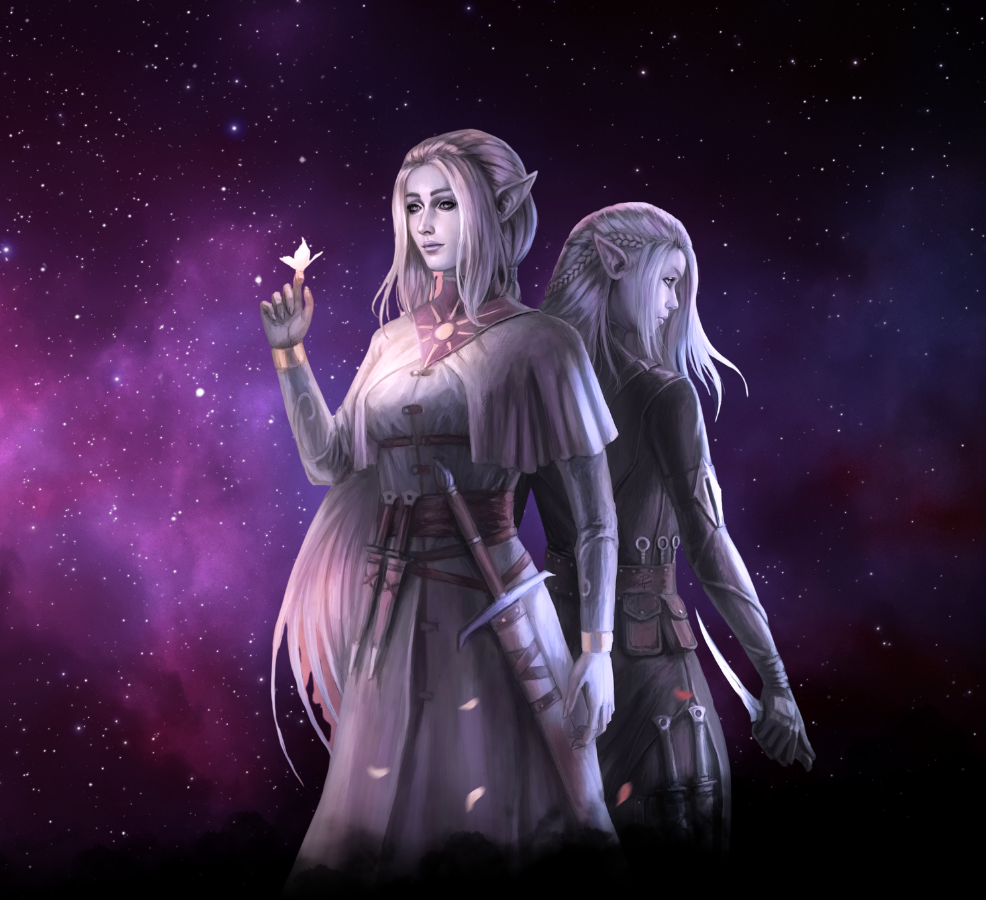
The Assassin Priestess: The Silver Wraith, Ch. 2
Chapter Two: The Gifted Star
On the afternoon I turned ten, a caretaker opened the door to the workroom and began calling us into the courtyard.
“Yvellis-Zero-Eight. Antyrir-Four-One. Isha-One-Three.”
She continued until every child in the room had been named. We set down our needles, awls, and scraps of cloth, then stood. No one asked why we had been summoned. Questions were permitted only when an adult expected one, and even then it was often safer not to ask.
I knew it was my tenth birthday because one of the caretakers had told me the date when I was six. She had been checking the orphanage ledger and complained that I had been entered on a winter day when the ink froze inside its well. She told me I had been born on that date, then struck me for asking what time.
The knowledge meant little to me back then.
Birthdays were not observed at the orphanage. A child received no gift, extra food, or relief from work for having survived another year. Each day began with the same bell and ended when the lamps were extinguished. Winter made the rooms colder. Summer made them hot, stagnant, and smell worse. Those were the most significant differences.
While I might have been ten years old, I remained no larger than a human child of five. My body was narrow from hunger, my wrists thin enough for an adult’s fingers to close around them twice, and my short silver-white hair had been cut with a dull knife three nights earlier. Had I not known the date, I would not have felt older.
All I felt was hunger.
We had received no supper the previous night. That morning, the breakfast bell had rung, but no bowls were brought. At midday, the caretakers entered the workrooms only to count us and ensure no one had hidden food on them.
By afternoon, hunger had ceased to be an emptiness. It had become a pressure beneath my ribs, a weakness in my legs, and a sour taste that remained no matter how often I swallowed. Several of the younger children had stopped speaking. One had vomited water and been struck for soiling the floor.
The omission of three meals was deliberate. We all understood this, though we did not understand its purpose.
The caretaker led us through the central corridor and outside.
Snow lay in thin ridges against the courtyard walls. The stones had been swept, but ice remained in their cracks and beneath the covered walkways. Our breath clouded before us. Most of us wore only work tunics, stockings, and shoes too worn to keep out the wet. We drew close together for warmth until the caretakers separated us with switches.
All sixty-four children of the orphanage had been summoned.
The orphanage director stood near the center of the yard. I had seen him often, though he rarely spoke to us himself. He left correction to the caretakers and appeared only when visitors came, when a child was being sold, or when a punishment required an audience.
On this day, a stranger stood beside him.
The first thing I noticed was the black.
Dark clothing was common in Assyrial, but the stranger wore no grey, blue, or silver to soften it. His fitted coat, high boots, gloves, and long mantle were all black. Even the metal fittings upon his clothing had been darkened so they did not reflect the winter light.
He carried more blades than any person I had seen. Daggers rested at both hips, crossed his chest, and lay against his forearms beneath fitted straps. Others protruded from his boots. I could see the shapes of still more beneath his coat, though I did not yet know enough about weapons to identify how each was secured. The only piece of jewelry I observed was a black circle surrounded by gold hanging on a blackened chain on his neck.
Years later, I would wear my blades in many of the same places. Along with that necklace.
At ten, I thought only that no one carried so many daggers unless he expected to use them.
Then he looked at me.
All Vael’sarí possess silver eyes. Shades vary, as do the rings and patterns within the iris, but the white around them remains white.
His did not.
The sclerae of the stranger’s eyes were jet black. His irises were so dark a silver that they nearly vanished within them, and from where I stood his eyes appeared to be two balls of polished obsidian. They reflected light without seeming to contain any.
I had seen men kill children. I had watched Usayir die. I knew that adults did not require a reason to cause pain.
That man’s eyes frightened me more than the director’s whip.
He examined each row as the children entered, but his attention returned to me. The first time, I told myself I had imagined it. The second time, I lowered my face. When I looked up again, those black eyes were still upon me.
There was interest in them.
I did not know then that interest could be more dangerous than anger.
The caretakers arranged us along one side of the courtyard. Some children leaned against one another until a switch parted them. Antyrir-Four-One found a place two children to my left. He was six, small even for his age, and had been ill for much of the winter. His cheeks were hollow. A bruise darkened the skin beneath his right eye.
I had begun watching over him several months earlier.
The resemblance to Usayir had not been deliberate. I had seen an older child take Antyrir’s blanket and had followed her until she left it unattended. I stole it back and returned it without telling him how. After that, I sat near him during meals, showed him where to hide crusts, and struck those who tried to take his portions when I believed I could win.
I was not as kind as Usayir had been. I wish to state that plainly.
I resented sharing food. I sometimes became angry when Antyrir cried. Once, when he woke me during a nightmare, I told him I would leave him alone if he did it again. He believed me, although I did not mean it. I had wanted to become for him what Usayir had been for me, but wanting goodness and possessing it are different matters. At the time, I was just mimicking Usayir’s actions.
Still, Antyrir trusted me.
He looked toward me now. I gave him the smallest nod I could without drawing attention. His shoulders lowered a little.
In the center of the courtyard, one caretaker placed five wooden balls upon the ground.
They were old things, each roughly the size of a small apple. Their surfaces had darkened with years of handling, and the grain had risen where water entered cracks in the varnish. One had a shallow split along its side. Another bore tooth marks.
Sixty-four children watched him arrange them in a straight line.
All the while, the stranger in black watched us.
When the caretaker stood, he rested both hands behind his back.
“You have received no food since yesterday’s midday meal,” he said.
This was not entirely true. A few children would have hidden something. Others might have caught insects or eaten candle ends. None corrected him, however.
“You will receive none today. You will receive none tomorrow. For the next seven days, food will be given only to the five children who obtain one of these balls and keep possession of it until the contest is ended.”
No one moved.
The words took time to settle over us.
I looked from the five balls to the rows of children. Five would eat. Fifty-nine would not.
A younger girl began to whimper. The child beside her covered her mouth before a caretaker could hear.
“Any child who refuses to participate,” the caretaker continued, “will be sold to the slavers before nightfall.”
At his declaration, the courtyard became very still.
The slavers had last come in autumn. We had been ordered into these same rows while prospective buyers walked among us, inspected our teeth, gripped our arms, and asked the director which of us obeyed best. Many had been interested in me, but the director had told them no for some reason.
Issylir-Four-Six had been chosen by a nobleman.
Issylir was eleven. He had a long face, large eyes, and a habit of pressing his lips together whenever he was frightened. He answered every question correctly. He knelt when commanded. A young nobleman who purchased him killed him in the courtyard before taking him through the gate.
There had been no argument and no provocation. The young man had wanted to discover what it was like to kill someone.
He laughed, paid the director for the body, and chose another child. Yanna-One-Six. She was fourteen.
I remember Issylir’s face. I remember the nobleman’s as well. One held terror; the other, mild amusement. For a very long time, I believed amusement was the crueler of the two because it required so little from the person who wore it.
Every child in the courtyard remembered what had happened.
No one refused the contest.
The caretakers moved us to the far end of the yard. The five balls remained perhaps forty paces away. Ice made the stones uneven between us and them. Children began shifting within the lines, checking the distance to the wooden balls, and to one another.
Antyrir edged toward me.
“Stay behind me,” I whispered.
He nodded.
I did not have a plan for what he should do after that.
The stranger spoke quietly to the director. The director listened without looking away from us. When the stranger finished, his black eyes found me once more. I shuddered under their gaze.
The caretaker raised one hand.
“Prepare yourselves.”
Children crouched. Some placed one foot behind them. Others curled their hands into fists. A boy in the front row began crying silently, though his body remained ready to run.
I knew what the caretakers intended.
They had used hunger against us many times. A single loaf left upon a table could turn friends into enemies. A cup of broth promised to the child who reported theft would ensure that no hiding place remained secret. If we distrusted one another, we would never stand together against those who harmed us.
I understood this at ten, if not in those words.
Sixty-four children outnumbered the director, the stranger, and the six caretakers in the courtyard. Had we all refused to participate, they could not have punished us all at once. Had we all rushed the kitchens rather than the wooden balls, some of us might have eaten.
But hunger does not encourage thoughts of us.
Hunger reduces the world to me and mine.
I knew the contest was meant to turn us against one another.
And I was still going to fight.
The caretaker lowered his hand.
“Go.”
All sixty-four children moved.
The first row fell almost at once. Those behind crashed into them, climbed over them, or were pulled down in turn. A body struck my shoulder. An elbow caught my mouth. Someone seized the back of my tunic, and the cloth tightened against my throat until I twisted free.
There was no room to run. We pushed forward in a single mass, each child trying to pass through spaces that did not exist.
I struck a girl in the ribs because she blocked me. I pulled another child backward by his hair. When a boy caught my wrist, I punched his face with my free hand until his grip loosened. Someone kicked the side of my knee. I stumbled, stepped upon a hand, and heard its owner scream.
The wooden balls vanished beneath legs and grasping arms.
Children who reached them were buried beneath those who followed. One ball appeared above the crowd in a raised fist. Three others seized that arm. The ball fell. A child caught it against her chest, and another bit her cheek until she released it.
The caretakers shouted encouragement as they laughed and placed bets.
Not instructions. Encouragement.
It was all a game to them.
Their laughter angered me more than the blows.
I drove my shoulder into the child before me. He fell against two others and opened a narrow path. I forced myself through it, taking a fist beneath my ear and a heel against my shin.
Then Antyrir appeared in front of me.
I do not know how he had passed me. Perhaps the crowd had carried him forward. He stood between me and the nearest ball, his eyes wide, one hand reaching toward it.
For an instant, we recognized one another.
He might have expected me to help him.
I placed both hands against his chest and pushed.
Antyrir left his feet. He struck another child and fell hard upon the stones several paces away.
His face changed before he landed.
The surprise vanished first. Then the hurt. His mouth closed, his eyes emptied, and every part of him became still. It was the face children in the orphanage learned to make when pain came from someone they had trusted. A schooled face. A face that revealed nothing because revealing pain invited more of it.
Usayir had never looked at me that way.
Antyrir did.
I had wanted to be like Usayir for him. In that moment, I became Enthalir instead.
I knew what I had done. And I immediately hated myself for it.
I still turned toward the ball.
Another child struck me across the jaw. I answered with my fist. Fingers closed in my hair and pulled until my head bent backward. I clawed at the hand, caught two fingers, and twisted until I heard the fingers snap. Someone drove a knee into my stomach. The air left me. I fell to one hand, rose, and was kicked between the shoulders.
Pain came from every direction. Hunger hollowed me. Anger filled what remained.
I was angry with the children who struck me. I was angry with Antyrir for having stood between me and food, though he had done nothing wrong. I was angry with the caretakers, the director, the laughing nobleman who killed Issylir, and the black-eyed stranger who watched, face unreadable, as though our suffering had been arranged for his benefit. Most of all, I was angry at myself for hurting Antyrir when I wanted to help him.
Most of all, I was angry because I understood the contest and obeyed it anyway.
Then I felt the warmth.
It began in my chest, near my heart.
At first, I thought someone had struck me there. The sensation was small and concentrated, no larger than a coin beneath my breastbone. Then it moved. Warmth spread across my chest and through my stomach. It entered my legs and arms. Strength returned to muscles that had begun to fail.
The courtyard sharpened around me. I could almost see a flow to the air.
I heard each child breathing. I felt the scrape of every shoe against stone. The air itself almost demanded to be controlled, as though it rested against my skin and waited for me to move it.
I did not know the word aether.
I knew only that something inside me had awakened.
A boy wrapped both arms around my waist and tried to drag me from the balls. A girl seized my wrist. Someone struck the back of my head.
I wanted them away from me.
All of them.
Go away. It was a simple thought.
The warmth answered.
It rushed outward from my heart faster than I could breathe. For one perfect instant, I felt stronger than than the hunger, stronger than the pain, and stronger than every hand upon me.
Then the strength became agony.
Fire passed through me from the inside. It filled my chest, climbed my throat, and drove behind my eyes. My bones seemed to burn within my flesh. I tried to scream, but my body had forgotten how to draw breath.
My vision narrowed.
There was a sound like stone breaking beneath the courtyard.
Then came the boom.
Hands tore away from me. The weight at my back vanished. Screams rose and moved outward as though the sound itself had been thrown.
Darkness covered my sight.
I remained conscious, though only barely. I knew my knees had struck the ground. I felt stone beneath my palms. Cold air entered my lungs in a ragged breath, followed by another. Sweat ran from my face and fell between my hands.
When my vision returned, I was alone in the center of the courtyard.
The five wooden balls lay near me. Two had rolled apart from the others, but all remained within reach. No child stood between me and them.
As I looked around, no child stood within thirty feet of me.
They had been thrown in every direction. Some lay upon the stones. Others had struck the walls or the covered walkways. One child hung across a low railing before sliding to the ground. Several cried. One clutched an unnaturally bent arm. Another tried to stand and fell again, blood pouring down from a cut on her forehead.
I looked for Antyrir.
He sat near the courtyard wall, holding one shoulder. His face had lost its careful emptiness. He stared at me with undisguised fear.
He was alive.
They all appeared to be alive.
Relief came first. Shame followed it.
I tried to stand and could not. My arms shook beneath me. The warmth had vanished, leaving a coldness deeper than the winter air along with a pain behind my eyes. Dizziness pulled the courtyard sideways. I closed my eyes until the world stilled.
No caretaker went to help the injured children.
The only one who moved was the stranger, slowly walking twards to me.
His boots stopped beside the nearest wooden ball. I stared at their black leather because I was afraid to raise my head. One of his daggers shifted softly within its sheath as he knelt.
“Look at me, child,” he said.
His voice was gentle. Kind even.
I obeyed unconsciously.
The black eyes were close now. I could see a narrow ring of dark silver within them, but the sclerae remained as black as polished stone. His face was long and composed, his white hair trimmed short. He appeared neither old nor young to me. Children raised in the orphanage often judge age by kindness; the older someone was the more likely they would cause pain. So far, his actions, nor his voice, had yet to result in any pain.
He smiled.
At ten, I believed it was a warm, sincere smile.
I had little experience by which to judge one. The mother in the street had smiled at her daughter, and Usayir had smiled at me before he died. I believed sincere smiles were evidence of affection because the few smiles given to me had been.
I know better now.
Looking back, there was satisfaction in the stranger’s face. Possession as well. His smile did not welcome me. It marked the instant he decided I belonged to him.
“What is your name?” he asked.
“Isha-One-Three.”
“No.” He raised one gloved hand and brushed damp hair from my forehead. I flinched, but his touch remained gentle. “You are now Isha.”
No adult had ever called me that.
He extended his hand warmly.
“Come with me, my daughter. I shall be your new father.” His smile widened. “I very much look forward to watching so gifted a star as you grow. You are gifted.”
His daughter.
My father.
I had dreamed of a mother, but a father belonged to a family as well. I knew this from stories. Fathers protected their children. They taught them crafts, brought food into the home, and punished those who tried to harm them. I did not yet understand that a person could use the language of love while intending none of it.
I looked at his waiting hand.
“Will I eat?” I asked.
“Yes, Little Star.” His black eyes held mine. “You need never be hungry again, so long as you obey me.”
It was not a promise of care. It was the first condition of my captivity.
I placed my hand in his willingly.
I would soon learn his name was Thalir.
The contest had never concerned five wooden balls. The hunger, the threats, and the violence had been tools used to force sixty-four frightened children beyond their limits. Thalir had come to see whether aether would manifest among us. Perhaps he had already suspected me. I have often wondered what the director’s ledgers said about Isha-One-Three, and what signs Thalir recognized before I felt the warmth near my heart.
I never asked him.
There are questions to which an answer grants no peace.
I remember looking back as he led me toward the gate. Caretakers had finally begun ordering the other children to stand. One bent to collect the balls. The contest was evidently over, though I do not know whether anyone was fed. None had obtained any of the balls. Antyrir remained near the wall. He did not look at me again.
Thalir had called me gifted.
For years, I believed my unconscious use of aether in that courtyard had saved me. That it prevented my sale to the slavers. That it removed me from the orphanage. It had given me food, training, status, and eventually power greater than any child in that yard could have imagined.
I was wrong.
My aether did not save me.
It merely revealed that I was valuable in a different way.
The aether I released that day nearly burned through me. A little more power, drawn with the same ignorance and desperation, might have burned my soul out entirely. My heart could have stopped before Thalir reached me. I would have died upon the stones with all five wooden balls close enough to touch.
I have spent much of my life rejecting the belief that death is mercy. The Children of the Night used that word to excuse murder and cruelty. They made oblivion sacred because it allowed them to call acts of evil a kindness.
Yet when I remember my tenth birthday, honesty requires me to admit something I would rather deny.
Had my soul burned out in that courtyard, it would have been a mercy. For me, and my many future victims.
I would never have learned the truth of Thalir’s so-called love. I would never have carried so many victims of my own. I would never have been taught how quietly a person dies when a blade enters from beneath the ribs. More than a thirteen hundred faces would not follow me into my nightmares.
Thalir’s smile remains among the clearest of them.
I remember the careful warmth he placed upon it. I remember the frightening black of his eyes and the gentleness of his hand around mine. I remember believing, for a few breaths, that my wish had finally been granted; that someone had chosen me because he intended to make me his child.
The ritual by which I entered the Kol family of the Morren clan was worse than anything that happened in the courtyard. It required obedience, a dagger, and dedication to a life I did not yet understand. And one I could never take back.
Three days later was when I first killed someone in order to join the family. That woman was someone who had tried to escape the life I was entering.
That was where I lost what remained of my innocence.
The courtyard was only where the man who would take it found me.
More From the Blog
News
Magi's Research Notes
Characters
Locations
Excerpts
Recent Posts