The Assassin Priestess: The Silver Wraith, Ch. 1
The Silver Wraith, Chapter One: The Fourth Way
My first memory was of the color red.
In it, there was a woman crying. I felt myself moving, though I could not tell whether she carried me or whether the world itself moved beneath us as her voice shook close to my ear. I recall something warm and wet touching the side of my face and beyond her shoulder. Regardless, I do remember a lot of red in my vision.
That is where the memory faded.
I believe I was only a few months old, though I cannot prove this. Memories do not bring dates with them unless I happened to know the date myself, and that one is too indistinct for me to judge my size by what surrounded me. Try as I might, I do not remember the tone her words, nor what she said. I do not remember where we were going, what terrified her, or whether her arms held me tightly out of love or desperation.
Most troubling of all, I do not remember her face. And for some reason, that makes me feel sad when I think about this one particular instance. In all others, I pray that I could forget their faces.
I am apparently unique in that facet of life.
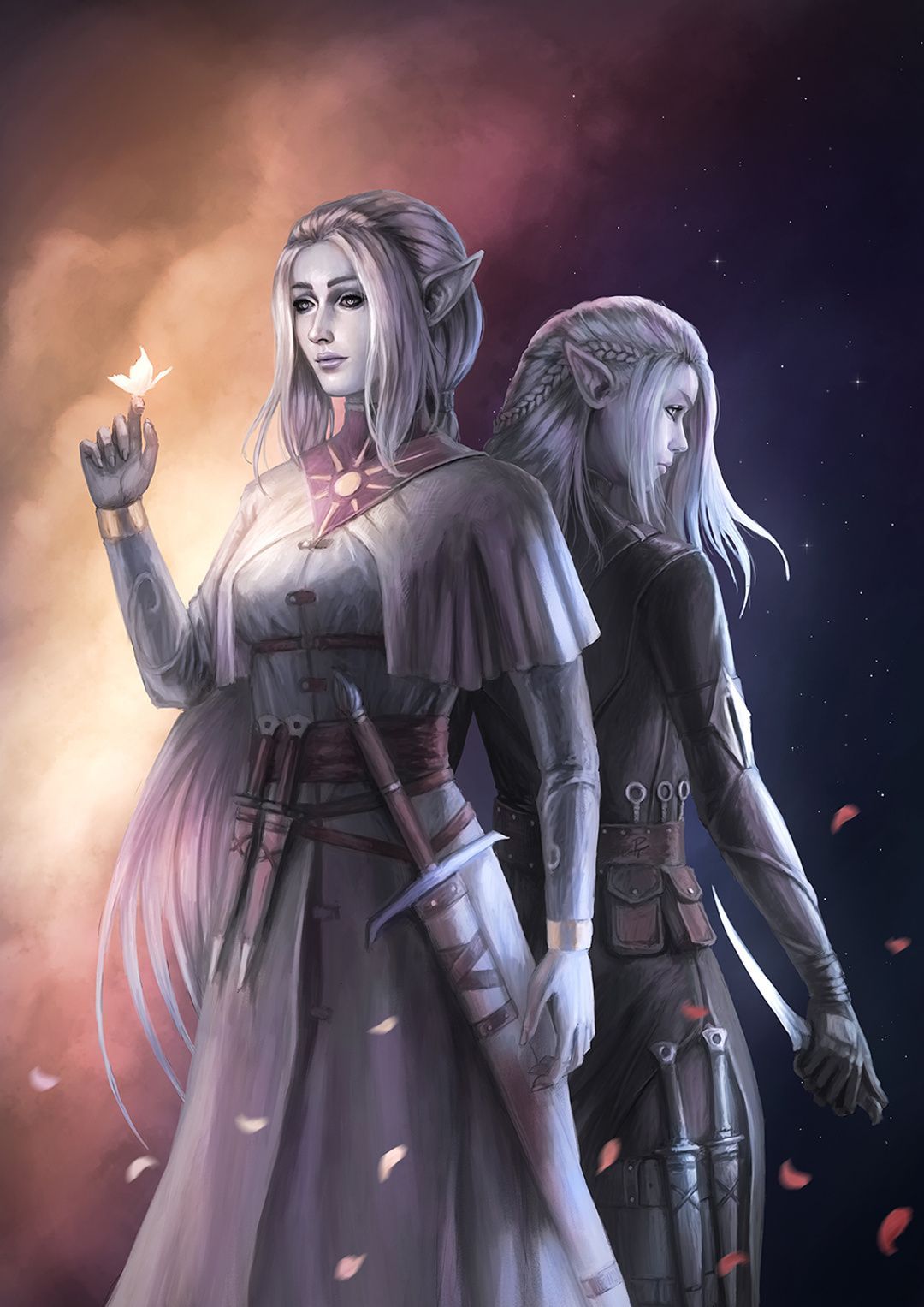
Faces have never faded from my memory as they do for others. I can close my eyes and see people whom I passed once in a crowded market centuries ago. I remember the precise set of a dying man’s mouth when he realized it was my blade that pierced his heart, or the shocked face and pleading eyes of a human countess as I strangled her with a cord of silk in her bedchambers. I remember the final looks of every man, woman, and child I failed to save, and every person I was ordered to kill in my three hundred years of life.
Time has softened none of them.
Yet the first woman of my memories is without a face.
For many years, I tried to give her one. I imagined high cheekbones, a narrow jaw, silver eyes like mine. All Váel’sarí share our snow-white skin, our silver-white hair, and our metallic-silver eyes, so those details revealed nothing. I could make her resemble anyone. That meant she resembled no one.
I know now that the red was blood.
I still do not know whose, though I doubt it was mine. I do not recall having any scars in my earliest memories.
My next clear memory came when I was four years old, after I was informed my name was Isha-One-Three; before I was given the cursed name I would try to bury.
Asyr’Isha Kol’Morren.
Among my people, I was physically little more developed than a human child of two, although I was often told that I learned too quickly and understood too much for my age. The caretakers at the orphanage told this to visitors when they came. They would rest a hand upon my head while they smiled their insincere smiles, call me an unusually capable child, and speak as though my quickness reflected well upon them. Their goal was to get rid of me.
When there were no visitors, the staff called me an annoyance. I stopped asking questions early on to prevent me being the focus of their anger.
I had learned to dress myself before the other children of my age. I could carry a bowl without spilling it, follow several instructions in their proper order, and repeat words after hearing them only once. The caretakers therefore moved me into a room with older children. I remember them saying I no longer required the attention given to the babies or other toddlers.
In truth, they just wanted me gone, like they did with all the children there.
There were too many of us and never enough food. Breakfast was thin grain boiled in water. At midday, we were sometimes given a piece of dark bread with a smear of rendered fat. Supper was whatever remained. I did not know then that hunger was supposed to end after one ate. I believed food merely made the aching lessen for a time. Though only given occasionally on special days, I fondly remember the treats of white bread and tiny portions of vegetable stew.
The older children were hungry as well, though even the oldest looked no older than a human child of seven. Some asked for part of my ration. Some just took it. Others struck me first so I would release it so I could not fight back.
I learned to eat quickly. I learned to hide bread inside my sleeve and to swallow even when my mouth was too dry, though I almost choked on the dark bread seventeen times before I turned ten. I learned that if someone watched my bowl, I should watch their hands. None of these lessons prevented everything.
There was always a bruise somewhere upon me, though not always given by other children. A yellow one fading beneath a new purple one. Finger marks around my arm. A dark place at my ribs where an adult’s boot had roughly woke me when I did not immediately rise before the dawn bell for prayers. The caretakers used switches when we spoke without permission, when we failed our chores, when we fought, and when we allowed another child to steal from us. A stolen meal was proof that we had been careless. Carelessness, they always said, required correction.
I did not think this was cruelty back then. I thought it was how every child grew up.
The orphanage was the largest building I knew. It had three floors, thick stone walls, an inner yard, and a gate reinforced with iron. Its windows were narrow, and most could be opened only far enough to admit air during the hottest months of the year. I had heard stories about castles, and at some point I decided the orphanage must be one.
I live in a castle, I would think whenever hunger kept me awake.
It seemed a grand thing when named that way.
One night, soon after I was moved to one of the older children’s rooms, I made my way onto the roof while others were fast asleep.
An older girl had once loosened the hatch above the linen room connected to our sleeping space. I had watched her slip through it and had remembered where she placed her feet. The hatch was high, but there were shelves beneath it. Near the outer ledge, I could reach a rain channel cut into the stone roof and pulled myself onto it.
The climb frightened me less than returning to the sleeping room. If I fell, the fall would hurt once. If a caretaker caught me up and about after dark, the switch would hurt many times. At the time in my life, this seemed an important distinction to me.
I lay flat against the cold tiles until I was certain no one had seen me. Then I crawled to the roof’s edge and looked out over the city.
Assyrial, the capital of the Váel’sarí Empire, was busy, even this late at night. Lamps shone along the streets and behind high windows. Carts rattled over the stones. Pale figures passed beneath me in colorful cloaks, their silver-white hair catching the light whenever their hoods slipped back. I could smell smoke, damp stone, cooked meat, and something sweet I had no name for.
I had never seen so much of the city at once. Until then, Assyrial had been a few streets glimpsed through bars and the upper portions of buildings beyond the orphanage wall. From the roof, I saw doors opening and closing. I saw people enter shops and emerge carrying wrapped parcels. I saw them turn down streets without asking permission, which surprised me. We had to ask permission for everything.
Then I saw the girl.
She appeared to be near my age. Her hair had been divided into two neat braids, each tied with a dark ribbon. She wore a blue cloak with silver stitching at its edges, soft boots, and gloves that matched. Her face was rounder than mine, with full cheeks and a small space between her two front teeth.
I remember each detail because she looked up.
The woman beside her said something I could not hear. The girl tipped back her head and laughed. The woman laughed as well, then bent to straighten the clasp at the girl’s throat. She took her time. When she finished, she brushed one thumb across the child’s cheek and left her hand there for a moment.
The girl smiled at her.
I had heard other children laugh in the orphanage, but such laughter was often followed by someone else crying. This was different. Neither the girl nor the woman had won anything. No one had been embarrassed or hurt. They laughed solely because they were together.
I knew what a mother was. I knew the word and its meaning, despite my young age. A mother was the woman from whom a child came, though I did not learn the specific details for a long, long time. I even knew some children got to live with theirs, unlike us. Until that night, however, a mother had been like a distant city or a creature from a story: something I accepted as real without understanding what its existence meant.
The woman reached for the girl’s hand and the girl gave it to her freely. They continued along the street, still speaking to one another, until another building hid them from me. I always wished I could hear them talking, though I could only read lips close up. To this day, I still find it difficult to read the lips of any other language than my mother tongue, A’lárian.
That night, I waited for them to return.
They never did.
That was when my castle became a prison. One that I longed to escape from.
Nothing about the orphanage had changed. The walls had not grown taller. The iron gate had not acquired a new lock. I had simply seen a child pass on the other side of them and understood that she could go wherever her mother led her, while I could go only where the caretakers permitted.
According to the stories we were occasionally read, a castle was a place where someone kept you safe.
A prison was a place where someone kept you locked up away from society.
That fall night, I remained on the roof until my hands became numb from the chill. I stared at the corner where the girl had vanished and tried to recall every movement of her face. I could not have said what love was. Had someone asked, I would likely have repeated a definition I had been taught.
But I had seen it.
I want someone to look at me that way, I remember thinking.
Once I understood that such a thing existed, I could no longer stop wanting it.
Usayir-Three-Three began looking after me a few weeks later.
He was eight, which made him twice my age and, in my estimation, nearly grown, though in reality he was still only a young child barely larger than myself due to how slowly our people age when compared to humans. He had the same snow-white skin, silver-white hair, and silver eyes that I had, as did everyone around us, but I would never confuse his face with another, even to this day. His chin came to a slight point, and his left eye narrowed more than his right whenever he suspected me of lying. Or when he lied himself.
Enshalir-Zero-Four, who was thirteen, had taken my midday bread three days in succession. On the fourth, I hid what I could not choke down beneath my tunic. He followed me behind the washroom, struck me hard enough that my lip split, and forced me to the ground in order to steal the dry, dark bread. He was kneeling upon my chest when Usayir found us.
Usayir could not have defeated him. He tried anyway.
He leapt upon Enshalir’s back and bit his forearm until Enshalir released me. Enshalir beat both of us for it. When it was over, Usayir wiped the blood from my mouth with the cleaner side of his sleeve and told me I should not hide food in my tunic tomorrow.
After that, he sat near me during meals when he could. Enshalir still stole my food and struck me on occasion, but he was less willing to do it when Usayir watched.
Our first long conversation took place on the roof a few weeks later.
Usayir had followed me through the linen-room hatch one night, although he claimed he had found the way himself. We sat behind the highest ridge, where we could not be seen from the inner yard. My back faced him as he drew a small wooden comb through my hair.
“Hold still, Isha-One-Three,” he said.
“I am still.”
“Your head moved.” He patted the top of my head softly.
“You pulled it.”
“Your hair is tangled.”
“Then do not comb the tangled part.”
He considered this and chuckled. “All of it is the tangled part.”
My hair was kept short, like everyone’s, to prevent lice and minimize the tangled mess my hair had become, but no one brushed it unless a visitor was expected. I did not like the way the comb caught when they did. I did, however, like the careful pressure of his other hand against the back of my head. He held each lock between my scalp and the knot so that there was less pain as he combed.
No one had done that for me before with such gentleness.
When he finished, he moved around to sit beside me. From beneath his orphanage-issued, worn, and ill-fitting white tunic, he withdrew a small piece of brown bread. It had been pressed nearly flat and was missing some of its crust.
“Here,” he said.
I stared at it. “Where did you get that?”
“The kitchen.”
I looked at him skeptically. “They do not give bread at night.”
“They did not give it.”
I paused for several seconds, cocking my head to the right, then stated, “Usayir-Three-Three... you stole it.”
His left eye narrowed. “It is still bread.”
I took it, then tried to break it in half. As I attempted to split the hard, dark brown bread, he closed my fingers around the whole piece.
“Eat it all.”
“You are hungry too.”
“I ate some already.”
He had not. I know that now. I may have known it then, based on how his left eye once again narrowed, but my own desperate hunger made the lie easier to accept.
I took a bite. The bread was dry and sour, as usual. It still remains one of the finest things I have ever eaten when I think back on my time in the orphanage since it was the first gift I remember receiving from anyone else.
Usayir watched the street below while I chewed.
After a long period of silence, he said, “There are three ways children leave.”
I looked toward the linen-room hatch. “There have to be are more. I leave that way.”
“That does not count. You come back inside.”
“Only because the roof is cold.”
“You still come back.” He pointed through the darkness toward the orphanage gate. “I mean leave forever.”
I stopped chewing, instantly interested in his topic of conversation. “How?”
“Sometimes a crafting family chooses one. You have to be chosen before you are fifteen.”
“What craft?”
“Any craft. Shoes. Stone. Metal things. Cloth. Whatever they think you can do.”
“Can they choose two?”
“Maybe.” I could tell from his tone that he did not believe it.
“Then we can go together.”
He did not reply my naive statement.
“What is the second way?” I asked at length.
“If magic does not come and no family chooses you by fifteen, they sell you.”
I knew that things were sold, I just did not fully grasp the concept then. “Children are not things.”
“They will sell us anyway.”
“To whom?”
“Slavers.”
“What do slavers do?”
“They take you somewhere else and make you work. Like in mines or on farms.”
“Crafting families make children work.”
“This is different.”
“How?”
He pulled one knee against his chest. “You cannot leave when you get older. You have to do everything they say, even if they hurt you.”
I looked back at the roof hatch through which we had climbed. “That is the same.”
Usayir’s face tightened. “Maybe.”
“Do slavers give food?”
“They must give some, but probably not much.”
I ate another small bite while I considered whether that made the second way better or worse. “What is the third?”
“Magic.”
“Magic is not a way.”
“If it comes to you when you are ten, the Temple comes for you. Then you belong to them.”
“Do they sell you?”
“No.”
“Do they hurt you?”
“I do not know.”
“Do they give food?”
He frowned at me. “You ask that about everything.”
“I like food.”
He laughed. It was quiet, but it was not cruel. For one moment, I thought of the girl and her mother.
Then his laughter ended.
“I heard two of the caretakers talking,” he said. “They thought I was asleep. One said it cost too much to keep all of us. She said they should just kill us now.”
I waited for him to tell me why this was important.
“The other one laughed,” he continued. “He said it would be a mercy, with whatever happens to us once we leave.”
“What is ‘mercy’?”
“It is when you stop someone from hurting, I think.”
“They stop hurting you?”
“No. I think you stop the hurt itself.” He paused for a moment as he thought. “Maybe.”
I considered that as well. I understood the words, but not the difference. “How does them killing us stop the hurt?”
“Dead people cannot hurt.”
“They cannot be hungry either.”
“No.”
“Maybe that is mercy.”
“Do not say that!” His voice became sharp enough that I flinched. He saw my reaction and lowered his head.
“Why not?” I asked.
“Because it is not a mercy for you if you are dead.”
“Why?”
“Because you are going to leave this place.”
“Which way?”
He looked toward Assyrial. “A good way, I hope.”
I finished the bread and licked the crumbs from my palm. “I know the good way.”
“You do?”
“A mother will choose me.”
He turned to me.
I told him about the girl I had seen. I described her blue cloak, her two braids, and the way she had laughed. I told him how the mother had fixed the clasp at her throat and touched her cheek and described each of their faces in detail. I explained that they had held hands even though neither of them was trying to pull the other anywhere.
“My family will be like that,” I said. “They will give me enough food, and I will learn to do what they want very quickly. I will do every chore correctly so they do not have to strike me. My mother will brush my hair softly like you, Usayir-Three-Three. She will be glad when I come into the room. They will be happy I am their child.”
Usayir said nothing.
“I shall tell her to choose you too,” I added. “You can be my brother.”
The pain that crossed his face lasted no more than a moment. I remember it more clearly than the city beneath us: the slight parting of his lips, the way his eyes lowered, and the effort it took him to smile when he looked at me again.
At four, I thought he was sad because he did not believe a family would take two children.
Now I understand that he knew wanting a thing did not cause it to exist. He may also have understood that being chosen for one’s usefulness was not the same as being loved. He could have told me and ruined my hopes. He could have laughed at me, as many of the older children would have done. What they would eventually do, without telling me why.
Usayir did neither.
“I hope you get your wish, Isha-One—“ He paused a moment. “Isha.”
Then he took the comb and began working at a knot he had missed.
For the next year, Usayir remained as near to me as the caretakers allowed. He showed me which floorboards I could use to hide bread without drawing rats. He taught me how to fall sleep with one arm over my stomach so a surprise blow from an older child would usually hit my arm or hand before my stomach and soften the impact. When Enshalir or another older child took my food, Usayir sometimes fought them to get it back or found something to replace it even when he was punished by the caretakers. Not always. He was a hungry child, not a god, and he possessed little more than I did.
What he had, he shared. I would always remember that.
Then, one day after the slavers came and took away several children for the mines, including Enshalir, he escaped the orphanage before our morning prayers to the Goddess of Darkness, Du’Tariál.
I awoke and the first thing I saw was his empty sleeping mat. I knew at once that he had not gone to the privy or been taken for punishment. His blanket was neatly folded. The small wooden comb he always hid away was tucked under my mat; it was his parting gift to me.
In my naivety, I thought he had found a fourth way to leave.
For most of that day, I was happy for him. The thought of him leaving on his own almost made me smile.
Almost.
The city guard brought him back shortly before the evening meal.
The caretakers ordered every child into the inner yard with shouts and switches. We were arranged in rows with the smallest at the front so none of us could hide behind the others. Usayir had been bound by his wrists to a post; a common punishment among my people. More dirt than usual covered his bare feet and the hem of his tunic. One side of his face was swollen, and there was blood beneath his nose, though his eyes remained open and alert, but afraid.
They found mine almost immediately, and he visibly bottled up his fear.
The overseer stood behind him with a whip.
“Look well,” she told us. “This is the fate of every child who attempts to run.”
The first stroke of the whip tore his tunic.
Several children cried out. A caretaker walked behind our rows and struck them until they were silent. When the second stroke fell, I looked down. A hand painfully seized my jaw and forced my face upward.
“You will watch, Isha-One-Three!”
So I watched.
The whip rose and fell. Usayir screamed at first. Then he bit his lip. Then he made no sound at all.
Red spread across the dirty white cloth and snow-white skin.
By then, I knew the color’s name.
The overseer repeated her warning again and again. I no longer heard every word. I heard the whip. I heard Usayir’s breath when he could still draw one. I heard two children behind me whispering a prayer to the Dark Goddess, and both were beaten for speaking out of turn.
I could do nothing.
That knowledge was not new, but it had never been so complete.
Near the end, Usayir lifted his head. I still do not know how he found the strength to do it to this day. His gaze moved across the first row until it reached me.
His mouth curved.
It was a small smile. It trembled and showed blood between his teeth, but it was real. He held my eyes, and his lips formed four words without sound that he knew I would understand.
I am free, Isha.
The whip fell again.
His face changed when he died. Every face does. Something leaves it as the eyes dim, the face relaxes, and finally freezes in place. At five years old, I could not have explained this. I only knew that Usayir, still bound to the post, was no longer looking back at me, his face half frozen in a tiny smile.
The caretakers continued for several more minutes. They wished to be certain we understood.
I did.
That night, I climbed onto the roof alone for the first time in a year. Assyrial looked exactly as it had before. Lamps burned. Carts moved. Doors opened for other people. I watched the corner where the mother and daughter had disappeared a year earlier, but neither of them returned. Looking back, I think I wanted to cry, but I could not. I still cannot remember why.
I thought about Usayir’s final words. At five, freedom at the orphanage meant only the absence of the caretakers. Now I know that freedom for him meant no one could starve him, beat him, sell him, or corrupt his soul at the Temple of Du’Tariál. He was beyond all of it.
His soul was now with the gods.
I also did not understand that, at the time, his smile had been one last kindness for me.
He had been afraid. I know this because I remember his face before the first stroke. Yet when he saw me, he hid that fear. He chose the last expression that I would remember of him, giving me the only gift he still could in the time that remained.
He knew I could never forget faces. We had talked about it often, among many other things, as we looked out upon the city.
Perhaps the crying woman in my first memory cared for me. Perhaps the blood was hers, and perhaps whatever she did that night saved my life. I have no face by which to judge her. I have only the color of red blood, movement, and a vague memory of her grief.
Usayir-Three-Three is the first person whose care I remember with certainty.
He was the first to give me food while remaining hungry himself. The first to touch my short hair without pulling it in anger. The first to stand between me and someone larger, though he knew he would be hurt. And he was the first to preserve one of my dreams when the truth would have destroyed it.
Though, I sometimes wished he had.
At the time, I did not have the words for what he gave me.
I do now.
Hope and love.
Usayir had told me there were three ways to leave the orphanage. He found the fourth.
Unfortunately, I could not find a fifth. There was no ‘good way’ for me to leave.
When I turned ten and my aether manifested, the Temple finally came for me.
More From the Blog
News
Magi's Research Notes
Characters
Locations
Excerpts
Recent Posts