I trust I need not explain how children are made; if you require that level of instruction, you should probably be reading a different sort of book. What concerns me here is how long each people carries a child, and how quickly those children grow. Humans are the baseline most use without thinking: roughly nine months of pregnancy, and an age of “maturity” somewhere between fifteen and eighteen years, depending on the kingdom and how badly it needs new soldiers or workers. High-aelvar and wood-aelvar both carry children for about sixteen months. The growth is uneven. Rapid for the first six, then markedly slower, but the result is the same: we do not consider our young truly adult until around one hundred twenty-five years of age.
Dverger are peculiar in the opposite direction. Their pregnancies last only six months, and their infants are the smallest of any people I know, yet they take a full forty years to reach what they regard as adulthood. Half-aelvar fall somewhere between patterns. My friend Esriella, herself half-aelv, carried her quarter-aelvar son for ten months; her own mother, a full-blooded high-aelv, told her she carried Esriella for twelve. It seems human partners can “pull” the timing of aelvar pregnancies forward, shortening what would otherwise be a longer gestation.
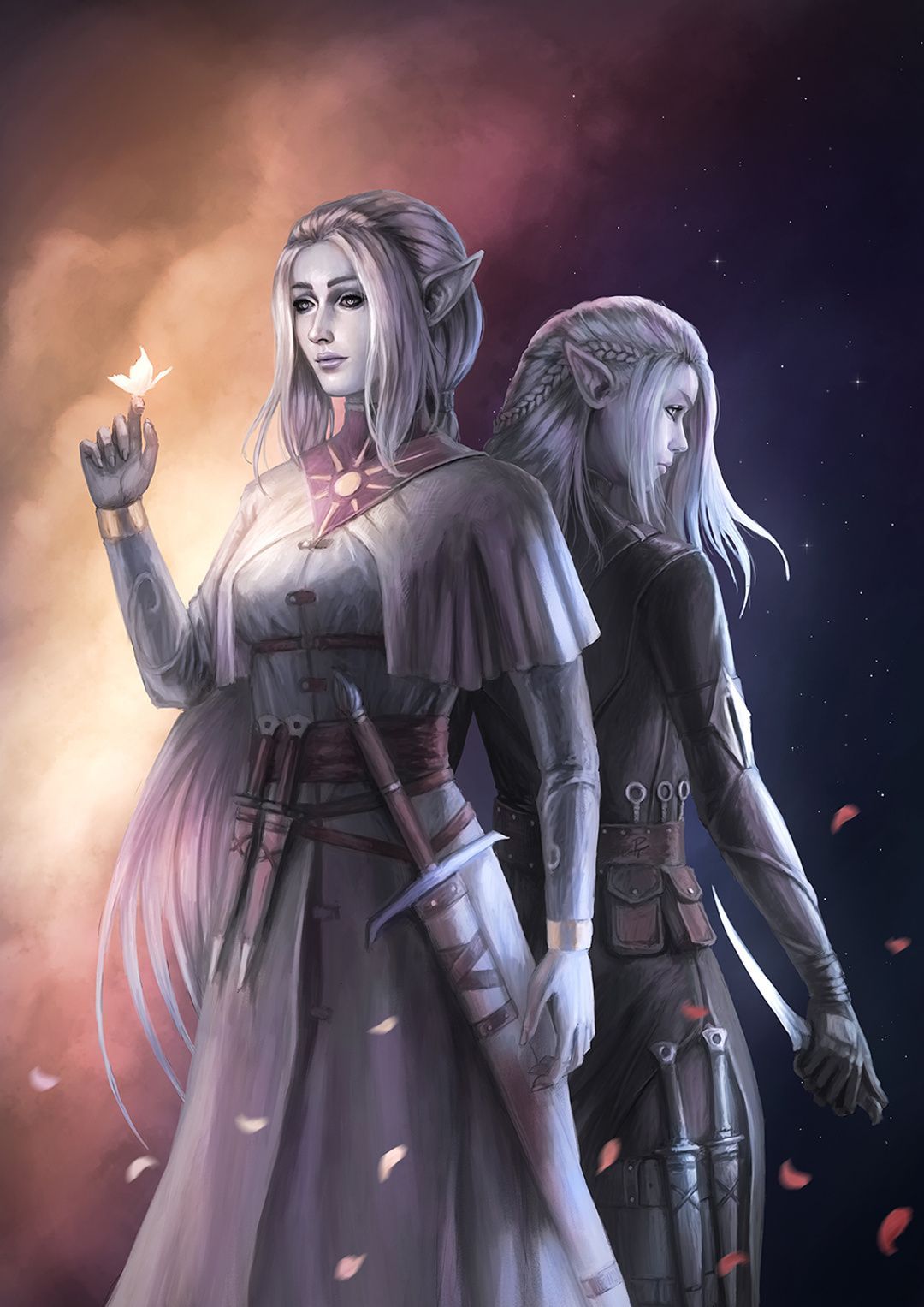
Of the pale-aelvar, my notes are frustratingly thin. Isha does not know how long her people carry their children; an ignorance I find both strange and unsettling. I would assume that they are similar to my own people, and the wood-aelvar, in this regard. Among the Vael’sarí, “maturity” appears to be declared rather than reached; one is an adult when told so, though she notes that no one remains a “child” beyond one hundred twenty-five years. She agrees this is the most honest marker, as pale-aelvar at that age look much like human youths of eighteen. Still, it troubles me that something so basic has never been explained to her. It says as much about what the Vael’sarí choose not to teach their young as anything they proudly claim to pass on.
I find myself wondering what Isha’s own “coming of age” looked like, and at what moment some pale-aelv family member or superior decided she was an adult to be used rather than a child to be guarded; but, based on what little she has let slip, I suspect I do not truly wish to know. Even now, any talk of her people draws a shadow over her face that speaks of memories best approached with care, if at all.
— from the research notes of Zyr’Magi Tes’Lothen, “Magi the Blade”, high-aelv scholar, mage, and swordsman