Seven Days
I had worked a forge for seven hundred and thirty-two years when a nightmare entered my workshop.
At age seven hundred and eighty, I had earned the right to shorten my days. I no longer opened before the first Temple bell. I left the heavy striking to my apprentices when the work did not require my own hand, and I accepted only the commissions that interested me or brought sufficient honor to my family.
Retirement was still nineteen years away.
I had selected my successor. My eldest daughter, and apprentice, had served me for two hundred and sixty-three years and could produce a soldier’s blade with no flaw that an officer would notice. In another twenty years, she might produce one with no flaw that I would notice. My family would retain the workshop, my name would remain stamped beneath its mark, and I would spend my final two centuries advising rather than working.
That was the order of things as laid out by the Goddess of Darkness.
I had earned respect. Members of the Twelve High Clans sent their stewards to my door. Officers waited years for my work. I had forged the ceremonial blade carried by the youngest son of the new Hivran High Family when he was declared an adult. I had repaired a spear belonging to one of the Night Sovreign’s personal guards. Three times in my life, I had been granted the honor to work aeteri steel.
No one hurried me.
But my peace was shattered when a child entered.
I saw her through the heat above the central forge. She passed beneath the black stone arch without announcing herself and stopped just inside the workshop.
My youngest apprentice moved toward her. “Orders are received at the front chamber,” he said, lacking the respect I would have preferred.
The child looked at him.
The apprentice froze.
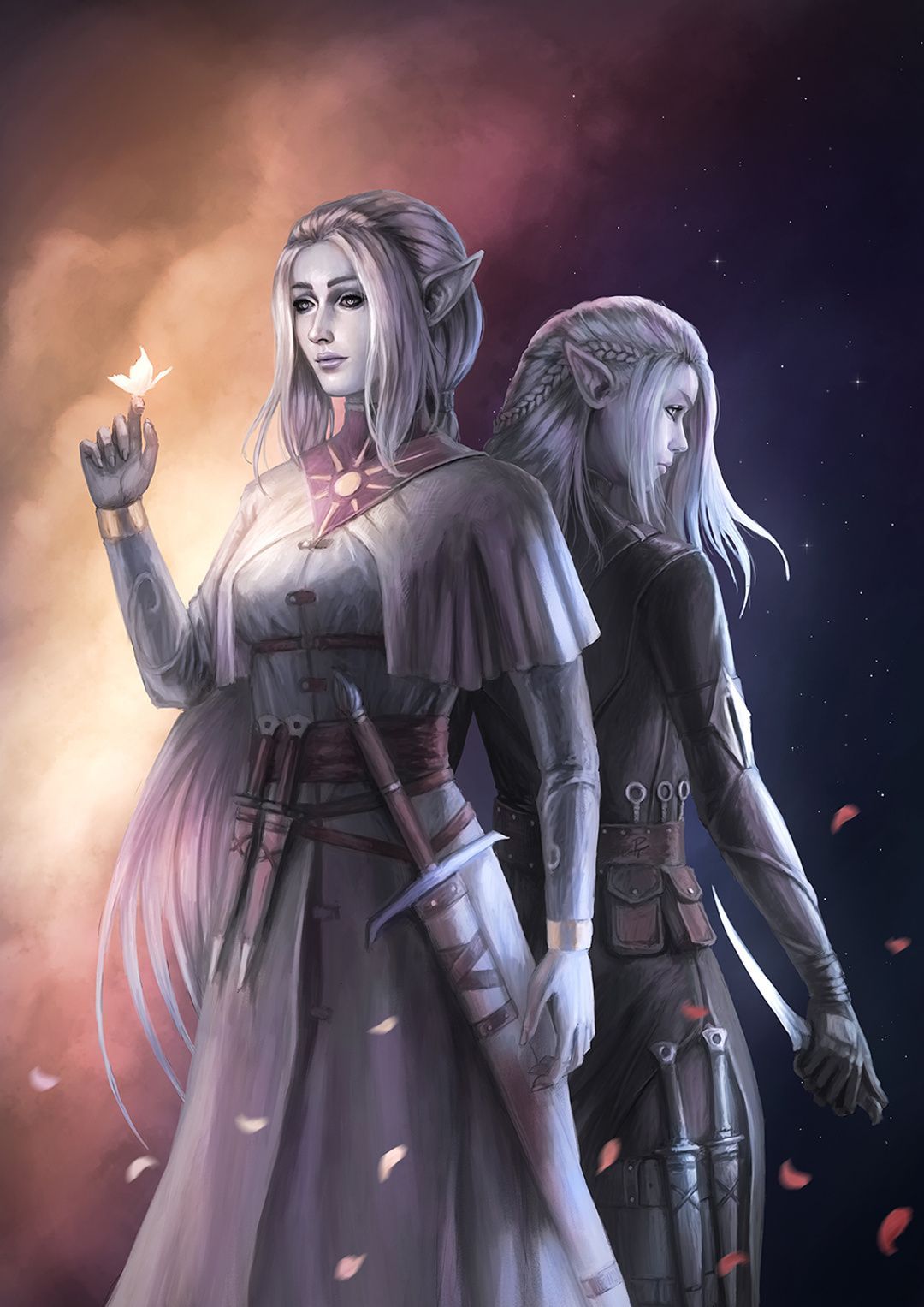
It was not her appearance that warned him. She wore a plain black robe fitted closely enough that it could not catch against a weapon. The sleeves ended above her wrists. Her hair, like all of our people, was silver-white and bound behind her head. Her face was smooth and young. She could not have been more than forty-five.
She was still a child, not yet old enough to celebrate the First Declaration that marked a Child of the Night’s passage into adolescence. A right I had undergone with my family at sixty.
My apprentice bowed so quickly that his forehead almost struck the floor. I almost failed to notice the dark stain spreading from his trousers and pooling between his legs.
That is when I saw it myself. She wore the black sun emblem of Morren Clan at her throat.
“Forgive me, Pr-priestess,” my apprentice stammered.
She gave no indication that she had heard him.
My mouth went dry, and I had to lock my knees to keep from stepping back from the young Morren girl standing in my shop.
She ignored us as her eyes moved across the workshop.
They passed over the three coal furnaces, the stone quenching troughs, the racks of tools, the unfinished weapons, and the six people who served under me. Two apprentices were our people, the Children of the Night. The others were thralls assigned to the workshop by my family’s estate overseer. She looked at each of them once.
The human thralls quickly prostrated themselves on the floor.
I lowered my eyes.
Commoners like me often claimed that they could recognize a Morren before seeing the clan mark. They spoke of unnatural silence, their perfect composure, or some change in the air around their clan. Most of those stories were nonsense told by people who wanted to appear observant.
They were all fools. The Morren Clan were the Night Sovreign’s enforcers against heresy. They watched the Twelve High Clans, carried out sanctioned executions, and granted the Goddess’ Mercy to those judged dangerous to the Empire’s order.
A hammer remained raised over a bar of heated iron. The apprentice holding it did not lower his arm until I ordered him to do so.
“Put it down, Yvalla,” I said.
The sound of the hammer touching the anvil rang out too loud in the silence workshop. The thralls tried to sink further into the ground.
The girl turned her silver eyes toward me.
I had been considered large from the date of my Second Declartion of my adulthood. My shoulders had broadened during my first century of work, and over seven centuries at the forge had given me more muscle than most soldiers retained outside active service. My hands were marked by burns. My right forearm was thicker than the girl’s waist.
None of that mattered. I knew instantly I would stand no chance against her daggers or her priestly magic.
I removed my leather apron, set it on the bench, and bowed. “Welcome to my forge, Priestess. I am its master, Asyr’Seyvyl Ys’Yuvel. How may I serve the Morren?”
I heard her approach as I kept my eyes locked onto the stone floor.
Her steps were short because her legs were short. She did not hurry. She stopped an arm’s length from me and raised her face to look in my eyes.
I had expected a child’s softness despite the emblem. There was none. Her expression held no pride, impatience, uncertainty, or curiosity. Children assigned to the Dark Lady’s Temple service often imitated the discipline of their instructors, but small betrayals remained. They glanced toward the fire. They stared at the weapons. They shifted when adults studied them.
This one looked only at me. Those dead eyes told me she had already given the Dark Lady’s Mercy to many.
“I am Aysr’Isha Kol’Morren,” she said. “Nightfang of Darkness.”
The hammer slipped from my apprentice’s hand and landed on the packed floor behind me.
No one moved to retrieve it.
This child, no, this priestess, was a Nightfang.
And she was one of the zealots of the Kol family.
I had heard the title during ceremonies and imperial announcements. Most citizens knew what it meant, although we were not expected to discuss the details. A Nightfang was not merely a priestess who killed. The Morren had many of those: the Veilshadows. Nightfangs were sent when a death carried significance. Heretics. Traitors. Clan rulers. Supposed prophets. Foreign commanders. Those who believed walls, guards, or secrecy could preserve them.
As for the Kols, they did not simply worship the Goddess. They devoted every breath, every prayer, and every killing to Her service. If the Dal’Morrens sold death, the Kol’Morrens worshiped it.
I focused on the small face in front of me.
Forty-two, perhaps. No more.
Someone within the Kol’Morren family had declared her old enough. No authority in the Empire would question that declaration.
I bowed more deeply.
“Your presence honors this workshop, Nightfang.”
“It does not.” Her voice was quiet, holding in it no emotion whatsoever. Fortunately, she did not sound offended.
I remained bent until she spoke again.
“I require a weapon.”
I straightened.
“Of course, Nightfang Isha.”
She removed a narrow black cord from around her waist. Several keys hung from it. She selected one and placed it on my workbench.
“Bring the chest.” Her tone was soft, barely loud enough for me to hear over the din of the outside street.
For a moment, I thought she was addressing me.
Then two figures entered from the street.
They were adult Morren, both dressed in black beneath dark traveling cloaks. One carried the forward handles of a small ironbound chest, the other the rear. Neither had entered with her. They must have waited outside while she examined us alone.
They placed the chest beside the key.
The bench creaked beneath its weight.
One of them looked at me.
“You will dismiss everyone.”
I nodded. I felt bile rise in my throat.
“All of you, out!”
My eldest apprentice hesitated. “Master, the furnace—”
“Bank it and leave.”
She obeyed.
The apprentices covered the heated pieces, reduced the bellows, and hurried into the rear courtyard, all shaking in fear. The thralls followed without being told twice. I watched until the last had passed through the door.
The two adult Morren remained.
Nightfang Isha picked up the key and handed it to me.
“Open it.”
The lock was finely made. I turned the key once and lifted the lid.
There were three wrapped bundles inside.
I knew what they contained before I touched them.
The chest itself had told me. The way the two Morren had carried it with reverence had told me. Most of all, the fact that they had brought it to me had told me.
I unwrapped the first bundle.
The metal beneath it was dark blue, almost black where the forge light did not strike directly. It had not yet been shaped into a proper ingot. The surface was uneven and marked with pale mineral lines. There was enough for a long blade.
Aeteri steel.
I had seen nobles kneel in mud over smaller quantities, begging the High Families’ to intercede on their behalf to obtain some from the Temple.
The second bundle held refined silver, charcoal made from a wood I did not recognize, and several sealed containers bearing priestly marks. The third held pale leather, black wire, and a length of white material that I first mistook for bone.
I looked closer.
A grip core. Carved and prepared.
I did not ask what living being it had come from. Priests always collected their own materials apart from the metal itself.
“You will forge a bastard sword,” Isha said.
I kept my eyes upon the contents of the chest.
“A bastard sword.”
“Yes.”
“For you?” I was confused. A bastard sword was a long blade with a two-handed grip. Much too large for a girl of her size.
Her flat stare gave me my answer.
The question had escaped my lips before judgment could stop it. I lowered my head.
“Forgive me, Nightfang. I ask only so that the weapon may be properly balanced.”
“It is for me.”
I considered her height and reach. The top of her head barely reached the lower portion of my chest. A properly proportioned bastard sword would be practically impossible for her to draw at her age and stature. Its weight would pull against her shoulders. Even with aeteri steel, which could be worked thinner than ordinary steel without losing strength, the length would create problems.
I knew weapons.
I had spent more years correcting the requests of arrogant army officers than this child had been alive. A customer asked for what they imagined. A smith gave them what their body could use.
The wise answer would have been to agree.
“Nightfang,” I said carefully, “a blade of that length may not serve you as well as two shorter swords.” I was apparently not old enough to possess wisdom, or the habit of self-preservation, and could not keep my mouth shut.
One of the adults behind her shifted.
I continued before fear stopped me.
“Two blades would allow you to use the material efficiently. Their length could be fitted to your current reach, with sufficient additional weight in the pommels to preserve their use as you grow. I could forge matched short swords now and alter their grips later.”
Isha said nothing.
“The balance of a bastard sword—”
“Look at me.” Her voice had an edge to it.
I complied immediately, barely controlling the shiver up my spine.
Her eyes were metallic silver, like all of our people’s, but hers looked as if they would swallow me in.
Our eyes often reflected the light, but hers seemed fixed and hard. Her face remained calm. There was no tightening around her mouth. No anger. No childish resentment at being questioned.
I would have preferred anger. I would have preferred any emotion at this point. If not for her eyes, she would look like a standing doll.
“I did not request two short swords, Child of the Night,” she said.
“No, Nightfang Isha.” I felt my throat tighten.
“I requested a bastard sword.”
“Yes, Nightfang.”
“You have been selected because you are said to understand the crafting of aeteri steel.”
“I do,” I replied after hesitating. It took a moment for me to find my voice.
“Then you will forge the weapon I have ordered.”
My mouth had gone dry.
“I intended no disrespect.”
“I know what you intended.”
That frightened me more than an accusation would have.
She took one step closer.
“You believe my body is insufficient for the blade. You believe my age permits you to correct me. You believe your knowledge of weapons grants you authority within your forge.”
Each statement was accurate.
I could hear the low movement of the furnace behind us. No one in the courtyard spoke.
“You are permitted knowledge,” she continued. “You are permitted skill. You are permitted pride in the service those things provide. You are not permitted to mistake them for authority.”
I bowed.
“Of course, Nightfang.”
“You will forge a bastard sword. The blade will be long enough for the body I shall possess, but balanced for the body I possess now. It will be usable with one hand or two. The edge will hold aether evenly from guard to point. The weapon will not resist a sudden increase in the amount directed through it.”
That last requirement made me raise my eyes.
Aeteri steel did not merely carry aether. It responded to it. Poorly worked aeteri steel could develop dead portions where the energy moved unevenly. Too much aether could heat a flawed blade, break its internal structure, or send the force back into the wielder’s hand.
I had once seen another Nightfang lose three fingers because a lesser smith had folded the metal incorrectly.
“What quantity of aether?” I asked.
“More than you believe the blade should endure.”
One of the adult Morren watched me closely. I could feel his murderous glare.
I nodded.
“I will allow for the highest concentration the material can survive.”
“No.”
I froze.
“You will allow for the highest concentration I can survive.”
I did not know how much that was. She knew I did not know. “How am I to determine that, Nightfang?”
She placed her right hand over the raw metal.
The metal shimmered as if it had come straight from the forge.
I felt pressure behind my eyes, then pain along old burns that had healed centuries earlier. The dark metal under her palm began to give off a low hum.
I stepped back.
The workbench trembled.
The iron tools hanging above it struck against the wall. The lid of the chest shifted. One of the sealed containers cracked down its center.
The two adult Morren did not react.
As Isha removed her hand, the sound ended.
A faint shimmer remained within the lines of the aeteri steel for no more than a second, then disappeared.
I noticed blood dripping from her nose, mouth, and ears down her white skin. Her breathing had not changed, nor had she flinched in pain, despite the knowledge that using aether caused pain to the user. Other than the blood, you would not even have realizes that she used her magic.
I looked at the raw material, then at her hand.
“At least that much,” she said.
I understood then why she had been declared a Nightfang. It was not because the Morren had ignored her age. It was because her age had ceased to matter due to her skill with blade and magic.
“I will ensure it,” I said.
“Good.” She took an offered rag from one of the other Morren in the room and wiped the blood from her face and neck.
I waited for her to finish before asking, “When do you require it?”
“In seven days.”
I thought I had misheard her.
Aeteri steel could not be hurried. It needed controlled heat, repeated folding, careful cooling, and periods of rest between stages. The sacred metal punished imprecision. A single inclusion could ruin the entire billet. A week was enough to prepare the metal for shaping, perhaps enough to begin drawing out the blade if I worked without interruption.
It was not enough to make my best weapon.
“You said I was selected for my understanding,” I said.
“Yes.”
“A weapon worthy of this material requires time.”
“You have seven days. That is all you will need with your skill and knowledge.”
I looked toward the furnace.
“To complete the blade, guard, grip, pommel, sharpening, testing, and aetheric examination?”
“Yes.”
I stood frozen, knowing to defy her courted death, but I pressed on, “Nightfang, that is not possible.”
She tilted her head slightly.
It was the first movement that reminded me of her age.
“Do you refuse?”
“I could never refuse you, Nightfang.”
The answer came at once. “Then it is possible.”
I felt heat against the side of my face, though I had moved away from the furnace.
“My apprentices will need to assist.”
“They may assist with ordinary preparation. They will not touch the aeteri steel.”
“That will make the work slower.”
“You will work more quickly.”
I had not slept properly for several nights after my first commission in aeteri steel. That blade had taken four months. The second had taken three. The third, completed when I was at the height of my strength, had required six weeks.
“You ask for my best weapon,” I whispered.
“I do.”
“But you give me seven days, Nightfang.”
“Yes.” There was nothing else in her answer. No threat. No explanation. No concern for the contradiction.
I examined the metal again. There was enough, but little excess. If the first welding failed, I could not begin again. If I overheated it, I would destroy material that belonged to the Morren. If the blade carried her aether unevenly, it might break in her hand.
The Morren did not forgive damaged sacred metal. I knew this one would surely not.
The Empire functioned because each person fulfilled the duty assigned to them. The Saelith supervised grain production and distribution. The Nemeran administered law. The Hivran preserved what was lawful to remember. The Temple instructed us in endurance and our Goddess’ Mercy. The Morren, the assassin-priests of the Temple, removed those who threatened the order of our society.
I had believed this all my life. I still believed it.
A citizen who performed his duty had no reason to fear.
That was what I taught my children.
The difficulty was knowing whether the Morren believed you had performed it.
“What form do you require?” I asked.
She reached into her robe and removed a folded sheet.
The drawing was precise. It showed a straight double-edged blade, long grip, modest crossguard, and a narrow ridge beginning near the guard, giving the blade a diamond profile. The proportions were those of a bastard sword made for a grown Child of the Night, but the guard and grip included a second set of balance measurements.
She had already accounted for her size.
I studied the figures.
The pommel would have to be replaced as she grew. The grip could be lengthened without remaking the tang if I followed the design exactly. Until then, the heavier pommel would draw the balance back far enough for her short reach.
My original objection had been correct.
It had also been unnecessary.
“You designed this?” I asked hesitantly.
“My Father provided the required dimensions. I corrected the balance.”
I looked at her again.
“You understand weapon construction?”
“I understand the weapon I desire.”
That was not the same thing, but I did not say so. Near the bottom of the page, a line of Kol doctrine had been written in formal script.
‘Mercy must not hesitate.’
Beneath it was the personal symbol of the Nightfang.
“What edge geometry?” I asked.
“Thin enough to part ordinary steel under aether. Strong enough to strike stone without chipping.”
“That requires opposing qualities, Nightfang.”
“The material permits them.”
“Within limits.”
“Then find the limits, Child of the Night.”
I swallowed.
“Yes, Nightfang.”
“The blade will have no ornament beyond the marks required by Morren. The grip will be pale. The guard and pommel will be dark. You will place your maker’s mark beneath the guard.”
That surprised me. Weapons produced for the Temple’s use often bore no commoner’s name. The family or order received honor for the work.
“My mark?”
“You will be responsible for it.”
The honor disappeared. If the sword served her well, few would ever see my mark. If it failed, the Morren would know exactly whom to find.
“I u-understand.”
She turned toward the door.
The two adult Morren lifted the empty chest away from the materials, leaving everything arranged across my bench.
I should have remained silent.
Instead, I asked, “When should I expect an aetheric examiner?”
She stopped. She slightly turned her head, and her profile reminded me of when my daughter was young.
“At the end of the seventh day, I will return and test it.”
My stomach tightened as I felt the bile rise back into my throat. A proper examiner increased the flow gradually, checking for uneven conduction. A weapon could be corrected before final sharpening if a weakness was found.
She intended to test it herself.
“With the force you demonstrated?”
“With what is required.”
“And if it fails?”
She looked over her shoulder. Her face remained impassive, seemingly devoid of all life’s joys and ills.
“Then it was not your best weapon.”
She resumed her walk toward the entrance.
I bowed and kept my head lowered as she passed. The two adults followed her. No one spoke until their steps had faded into the street.
Even then, I waited.
I counted fifty breaths.
My legs began to hurt before I straightened.
The workshop was unchanged. The furnaces still burned. The tools remained in their proper places. Light entered through the high vents. Voices and carts continued beyond the walls. Assyrial had not noticed that Nightfang Aysr’Isha Kol’Morren had entered my life and left it again.
I released the breath I had been holding.
From the rear courtyard, my eldest apprentice called, “Master?”
“Remain there,” I yelled back. I placed both hands on the workbench and suddenly realized they were shaking.
I had faced furnace bursts. I had held a broken support while my apprentices escaped a collapsing workshop. I had stood before ruling-family stewards and told them their chosen designs were foolish. At six hundred and twelve, I had killed a thief who entered my home.
A child had just frightened me more than any of them.
No.
Not a child.
The Morren had declared otherwise.
I looked at the aeteri steel. The metal remained dark, seemingly drinking in the light of the room, but I remembered the shimmer surrounding it and the sound it had made beneath her hand.
Seven days.
I began calculating heat, time, and labor. The first preparation would take the rest of the day. The initial weld had to be completed before the next temple bell. I could sleep while the billet cooled, though no more than two hours. My eldest apprentice could prepare the grip materials. The others could maintain the furnaces, bring food, and ensure that no customer entered.
I would need to work every hour my hands remained steady.
My retirement no longer seemed close.
If I succeeded, a Nightfang would carry my blade. It might serve her for centuries. It might cut armor, stone, and the bodies of those the Morren judged deserving of the Goddess’ Mercy. Generations of smiths might study it after my death.
If I failed, my family could lose the workshop.
I could lose my name.
The Temple might decide that wasting sacred metal required more than execution. A public sacrifice would remind other artisans that age, reputation, and service did not excuse failure.
I closed my eyes to steady my hands and my thoughts.
The Goddess of Darkness granted each of us a place.
The wise remained within it.
I opened my eyes and reached for my tongs.
“Bank the lesser furnaces,” I called. “Clear every commission from the schedule. No one enters this room without my permission.”
My apprentices returned slowly.
They stared at the material on the bench.
“Is that—” the youngest began.
“Do not name it, fool!” I shouted.
He closed his mouth. He had made a fool of himself twice in one day.
My eldest apprentice, my daughter, looked toward the doorway through which the Nightfang had departed.
“How long have we been given, Master?”
I lifted the raw aeteri steel with both hands.
“Not even one Lesser Turn. Seven days.”
More From the Blog
News
Magi's Research Notes
Characters
Locations
Excerpts
Recent Posts